


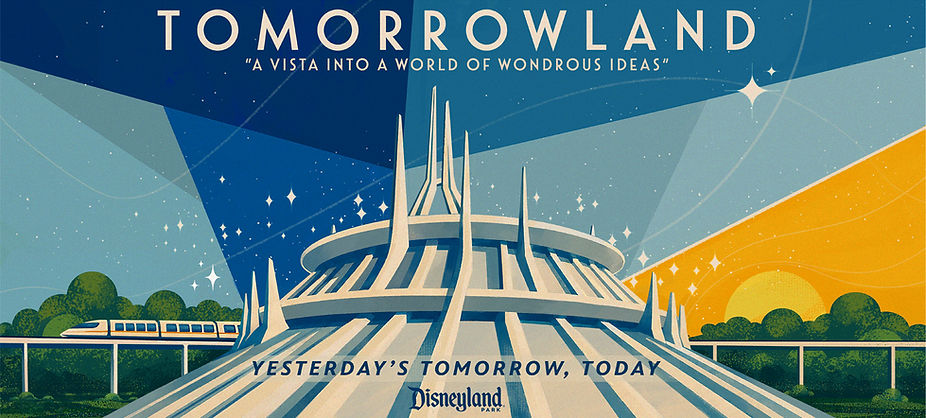
The Evolution of Tomorrow:
How Imagineering Is Fixing the "Land of Yesterday"
Disneyland Park is preparing for one of the most significant transformations in its 70-plus-year history: a ground-up reimagining of Tomorrowland. Officially unveiled by Disney Parks leadership at D23 2026, the overhaul seeks to resolve a dilemma that has plagued theme park designers for decades—how to design a "future" when real-world technology repeatedly catches up to and surpasses fictional worlds.
The Historical Bottleneck: Four Eras of Tomorrowland
When Tomorrowland opened on July 17, 1955, Walt Disney dedicated it as a space to showcase "a vista into a world of wondrous ideas, signifying man's achievements". However, keeping pace with human technological progress proved notoriously difficult. Over the decades, Imagineers revised the land’s core design philosophy multiple times:
1955: "A vista into a world of wondrous ideas" (Opening Day)
1967: World of Tomorrow & Space Age Kinetic Architecture
1998: Retro-Futurism, Steampunk Aesthetic & Bronze Palette
2026+: Optimistic Future, Kinetic Movement & Architectural Harmony
-
1955 (Opening Day): Built on a tight budget and short timeline, the original land relied heavily on corporate sponsorships (such as Monsanto and Kaiser Aluminum) to showcase immediate mid-century technological achievements like the House of the Future.
-
1967 ("New Tomorrowland"): Walt Disney's final major master plan introduced a sleek, googie-inspired vision dominated by kinetic movement—featuring the PeopleMover, Rocket Jets atop the central platform, and the Submarine Voyage.
-
1998 ("New Tomorrowland '98"): Inspired by Disneyland Paris's Discoveryland, Imagineers applied a bronze, Jules Verne-esque retro-futuristic overlay. While visually distinct, the design quickly aged and created severe pedestrian congestion.
-
2026+ (The Modern Reimagining): The new direction returns to Walt Disney’s foundational principles: optimism, human potential, and open exploration. Rather than predicting short-term hardware that quickly dates itself, Imagineers are constructing an adaptable, timeless environment.
Master Plan & Structural Overhauls
The upcoming transformation goes beyond cosmetic repainting, addressing long-standing structural infrastructure challenges:
-
Pedestrian Flow & Space: Disused elevated trackways and structural pinch points at the entrance will be reconfigured to open up wider walkways, shaded seating, and central gathering spaces.
-
Energy & Kinetics: Disney plans to restore a feeling of active motion across the land using modern lighting systems, dynamic water features, and elevated transport tracks.
-
Sustainable Transportation: Autopia’s classic gas-powered engines are being fully retired in favor of zero-emission electric powertrains, reflecting modern sustainable transit.
Space Mountain - Retained & Enhanced Anchor attraction receiving upgraded queue systems, structural refurbishments, and modern effects.
Autopia - In Transition Conversion from internal combustion to zero-emission electric vehicles.
Star Tours & Buzz Lightyear - Active Operations continue during initial phases while long-term integration plans are finalized.
Central Plaza & Concourse - Redesign Stage Removal of bottlenecks to establish expansive, park-like open spaces.
Project Timeline & Strategic Context
Disney Parks has prioritized the Tomorrowland project as a core focal point of its multi-year capital investment program at Disneyland Resort. Because the overhaul involves major infrastructure work across a dense portion of the park, construction will proceed in phased stages to keep key attractions open during guest visits.
By shifting away from short-lived tech trends and grounding the land in timeless architectural forms, sustainable engineering, and human imagination, Imagineering aims to finally give Tomorrowland a permanent future.
